“What we are watching unfold around Caitlin Clark and Sophie Cunningham is a window into what happens when a culture abandons objective truth and replaces it with ideology. From a biblical worldview, there is a larger issue beneath it all.”
Full Title;
Something Deeply Revealing Is Happening Inside The WNBA, And It Has Become About Much More Than Basketball
Start of Article;
Something deeply revealing is happening inside the WNBA, and it has become about much more than basketball.
What we are watching unfold around Caitlin Clark and Sophie Cunningham is a window into what happens when a culture abandons objective truth and replaces it with ideology. The controversy now involves race, transgender ideology, women’s sports, accusations of white privilege, treatment of fans, player safety, and a league struggling to handle two enormously popular players who have brought tremendous attention and money to women’s basketball.
From a biblical worldview, there is a larger issue beneath it all. This is what Romans 1 and the last days look like when ungodly principles work their way into a culture and take over.
Paul describes humanity rejecting the truth of God, suppressing truth, exchanging what God created for something else, and eventually reaching the point where moral categories become inverted in the last days. The progression is important. Once God is rejected as the ultimate authority, man does not become neutral. He creates another authority. Eventually, what should be obvious becomes controversial, and what should be controversial becomes celebrated. That is increasingly what we are seeing in professional women’s basketball.
The Sophie Cunningham Incident
On August 8, Chicago Sky guard DiJonai Carrington struck Indiana Fever guard Sophie Cunningham across the face and neck area while Cunningham was attempting a layup. Officials reviewed the play, upgraded it to a Flagrant 2 foul, and ejected Carrington. Cunningham was left with a bloody mouth.
The foul was so bad that Florida Attorney General James Uthmeier said the WNBA would have faced a different response in his state. He said, “The WNBA knows better than to play games down here in Florida, because I’ll be charging people with assault and battery.” And, by the way, Caitlin Clark has been receiving the same kind of physical abuse from other players as well. This is why the WNBA does not play in red states. Attorneys general in red states would be prosecuting these female thugs.
But what happened afterward made the incident much bigger. Carrington posted the words: “WHITE PRIVILEGE.”
And this is from a woman who violates her own inverted WOKE values of cultural appropriation by wearing a white wig. Just imagine what people would say if Clark or Cunningham wore dreadlocks.
Think about the cultural inversion represented by that controversy. A player receives a Flagrant 2 after clotheslining another player in the head and neck area, and almost immediately the discussion moves from whether the foul was excessive to race and privilege. That is precisely the problem with viewing human beings primarily through ideological WOKE categories of oppressor and oppressed.
The biblical worldview begins somewhere completely different. Every human being bears the image of God. Every individual is morally responsible for their actions. Biblical justice does not ask which racial category a person belongs to before determining whether an action was right or wrong. It judges the action.
Even Cunningham’s Coach Became Part of the Controversy
Indiana Fever coach Stephanie White initially said that Carrington is a fierce competitor and that she did not believe Carrington intentionally went for Cunningham’s neck. Huh? What? Are you gaslighting us?
White subsequently delivered an emotional pregame rant amid criticism that she had failed to protect them in the incident. She said she would lead with love, grace, humility, and integrity and condemned what she viewed as attempts to divide the team. Bologna!
Not defending your player against what could be viewed as a serious physical assault is not love, grace, humility, or integrity. It is cowardice in the face of the WOKE ideology that she fears.
The controversy itself demonstrates how politically and culturally charged the environment surrounding the WNBA has become. Because of the WOKE ideology it embraces, the WNBA has become more like World Wrestling Entertainment. People cheer for Clark and Cunningham to be beaten up by gangster-type players who punch people in the throat or clothesline people. This is how a straightforward question about a violent basketball foul quickly became entangled with arguments about race, transgender issues, privilege, ideology, and politics. Basketball seems secondary for the WNBA, its league officials, coaches, and players.
Sophie Cunningham Committed Another WOKE Sin: She Defined a Woman
Cunningham had already become controversial for an entirely different reason. She publicly defended maintaining women’s sports for biological females. Her argument was straightforward: women and girls should not have to compete athletically against biological males. Simple, common-sense, and biblical.
She also made clear that her position was not based upon hatred toward transgender people. She argued that people should be treated with love while simultaneously maintaining biological distinctions in athletics. That should not be revolutionary.
The entire reason women’s sports exist as a separate category is that men and women are biologically different. If biological sex is ultimately irrelevant, then the philosophical justification for having a separate women’s league begins to disappear. Even the name tells you what the organization exists to protect: Women’s National Basketball Association.
Yet the league has found itself debating the meaning and boundaries of the very first word in its name. Its collective bargaining language says only women are eligible to play in the WNBA, while current reporting notes that the provision does not specifically exclude transgender women.
From a biblical worldview, the underlying issue goes much deeper than basketball. Genesis 1:27 says: “Male and female He created them.”
Male and female are not arbitrary social categories invented by human beings. They are part of God’s created order. That does not permit Christians to mistreat transgender people. Every person should be treated with dignity and compassion. But compassion does not require Christians to deny biological reality. Truth and love are not enemies.
When Girls Supporting Women’s Sports Become the Problem
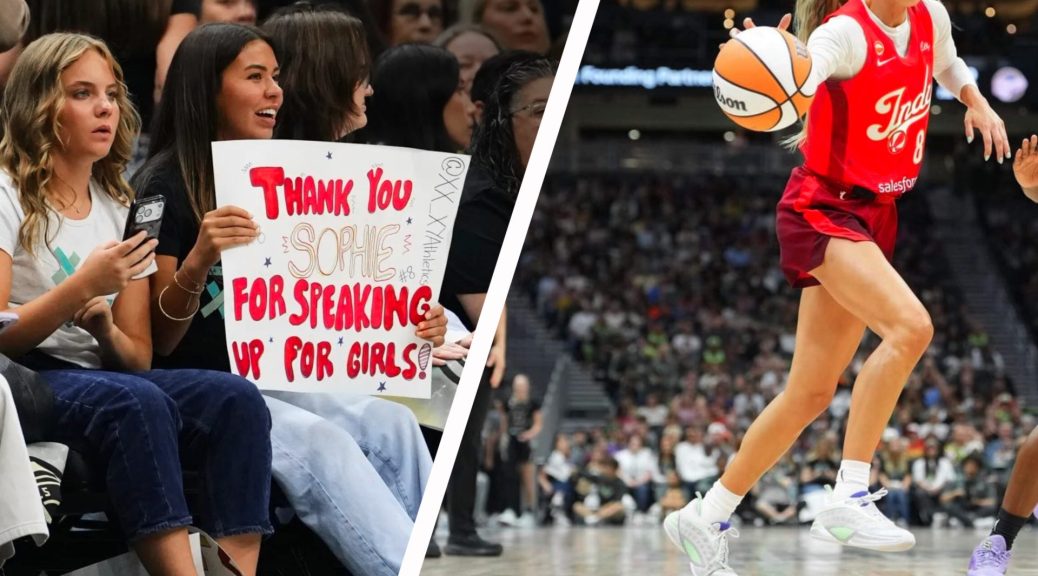
Perhaps one of the most revealing episodes occurred in Seattle. Two teenage girls attended a Seattle Storm game carrying a sign supporting Cunningham for speaking up for girls. Seattle Storm minority co-owner Celeste Keaton confronted Sophie’s fans and directed expletives toward them. The teenagers were wearing shirts displaying XX and XY chromosomes and holding signs that read, “Thank you, Sophie for speaking up for girls,” expressing support for Cunningham’s recent public stance opposing transgender women competing in women’s sports.
According to reports, Keaton approached the girls courtside, directed expletives at them, called them “f—ing insane,” and said things including, “How dare you come here and pull this s–t,” “You better stop this s–t,” “I hope Jesus can forgive you for what sin you’ve done,” “God can save you,” and “Jesus loves everyone.”
How ironic and hypocritical. A lesbian married to another woman who supports transgender men pulls the false Jesus shame-and-condemnation card on teenage girls who are actually representing Genesis 1–2. What hypocrisy. What Pharisaism.
The fact that such an incident happened at all reveals how upside-down and immoral the cultural conversation has become. A women’s league should be one of the safest places in America for the protection of women from biological males competing as females and for teenage girls to exercise their free-speech ability to say: Protect women’s sports. Instead, that message itself has become blasphemy to the WOKE religion.
Caitlin Clark Changed the Economics of Women’s Basketball
There is another extraordinary contradiction running through this story. The WNBA is experiencing unprecedented economic growth because of one player, Caitlin Clark. The NBA has historically subsidized the WNBA and has struggled to become consistently profitable. For years, comparatively few people wanted to watch it, and even many women preferred watching the NBA. But Caitlin Clark changed the economics and visibility of women’s basketball.
The league’s new collective bargaining agreement announced in March dramatically increased player compensation. The salary cap was set to rise from $1.5 million in 2025 to $7 million in 2026, with average salaries projected above $583,000 and maximum salaries reaching $1.4 million.
Caitlin Clark has unquestionably been the central figure in the explosion of interest surrounding women’s basketball. She brought millions of people who previously paid little attention to the WNBA into the sport. Television audiences grew. Ticket demand grew. Media attention exploded. Corporate interest increased. Suddenly, people who could not name three WNBA players were watching games.
She is the Michael Jordan of women’s basketball, but there is a problem: she is white and straight, which does not fit the WOKE narrative that dominates much of the WNBA. Then there is Sophie Cunningham, who has emerged as another highly recognizable figure within that expanding audience. But there is another problem. She is white, straight, a Christian, and bold enough to speak truth against the WOKE narrative of the WNBA.
These women should be treated as enormously valuable assets to the league. These two athletes are the golden geese of the WNBA, but instead, they are treated by players, coaches, the league, and officials like trash. Why would the WNBA treat these two stars as badly as it does? The hostility surrounding these players is extraordinarily self-defeating. It is the proverbial killing of the golden goose.
The Poison of Identity Politics
There is also something deeply unhealthy about reducing every conflict to racial categories. Carrington’s “WHITE PRIVILEGE” reaction demonstrates the problem.
It is entirely legitimate to discuss racism where racism actually exists. Christians should condemn genuine racism because Scripture condemns partiality and because every race shares the same human ancestry and bears God’s image. But interpreting interpersonal conflicts primarily through racial power categories produces another form of partiality. You stop seeing people. You start seeing categories: white, black, oppressor, oppressed, privileged, victim.
That framework comes from Marxist conflict theory, in which society is understood primarily as a set of competing power groups. Biblical Christianity offers something radically different. Acts 17:26 states that God “made from one man every nation of mankind to live on all the face of the earth.” Therefore, all people are descended from our common ancestor, Adam.
That does not mean biological distinctions cease to exist. Paul obviously continued recognizing male and female, and Jew and Gentile distinctions. But it means that those biological distinctions, or ethnic distinctions, do not determine spiritual worth before God. The Bible, therefore, rejects racial favoritism.
Lesbianism Has Become Part of the WNBA’s Public Identity
The WNBA has also increasingly associated itself publicly with LGBTQ advocacy. In fact, close to 40-45% of the league are lesbians. Outsports.com. That is disproportionate to society since only 1.1% identify as lesbians in the United States.Worldmetrics.org. It really is not simply about basketball anymore; it has become intertwined with a WOKE ideology that promotes what Scripture identifies as sexual immorality.
Christians are equally free to say that Scripture establishes God’s design for sexuality and marriage. But we are not immune from persecution from those to whom this truth is spoken, as Sophie has experienced.
Biblical Christianity teaches that sexual intimacy belongs within marriage between a man and a woman. That standard applies to heterosexual sin just as surely as homosexual behavior. However, the WNBA increasingly reflects the broader sexual ethic of our culture—that sex and relationships can be defined according to personal desire rather than God’s created order.
The issue therefore is not that one particular group is uniquely sinful, since all have sinned and fall short of the glory of God. The issue is whether God possesses the authority to define human sexuality at all. Increasingly, modern culture, like the WNBA, answers: No. Romans 1 answers: Yes. And that brings us back to the real issue.
Romans 1 and the WNBA
Romans 1 is sometimes reduced entirely to homosexuality. That misses Paul’s larger argument.
The chapter describes humanity’s rebellion against the Creator. First comes the suppression of truth. Then comes the exchange of God’s truth for man’s version of reality. Then created things become more authoritative than the Creator—idolatry begins. Then moral disorder follows. Eventually, society reaches a stage where sinful behavior is not merely practiced but approved and celebrated.
That pattern is enormously relevant to modern America and the WNBA. When a women’s professional sports organization struggles to clearly articulate why biological sex matters to women’s sports, something has gone terribly wrong. When teenage girls supporting female athletics become controversial, something has gone wrong. When a brutal basketball foul immediately becomes a racial grievance, something has gone wrong. When identity politics becomes more important than individual responsibility, something has gone wrong. When disagreement with LGBTQ sexual ideology is routinely characterized as hatred, something has gone wrong.
This is bigger than basketball. This is worldview.
The Contradiction of Modern Feminism
Perhaps nothing demonstrates the ideological confusion more clearly than the transgender debate.
For generations, radical feminists protested the male patriarchy, burned their bras, and fought to create athletic opportunities specifically for women. Now they have those opportunities, and they are willing to give them away because of an intersectional hierarchy in WOKE ideology where transgender males can be given priority over biological women.
Now WNBA Commissioner Cathy Engelbert is convening a task force of team presidents and general managers to discuss transgender-athlete eligibility. Engelbert sent a memo emphasizing “integrity” and “fair competition,” acknowledging that the issue is “complex and nuanced” while confirming that the task force will address eligibility standards at an upcoming meeting.
Hey, Engelbert, it is really simple: biological males should not be allowed to play women’s sports. Follow the science—not how someone feels.
But that is what happens when you lack a biblical framework. You lose the objective foundation necessary to make common-sense decisions. And if the league allows biological males to compete against women, it will ultimately destroy the very athletic rights women fought for in the name of accommodating transgender athletes. Think about this.
Title IX transformed women’s athletics. Female athletes fought for scholarships. They fought for facilities. They fought for professional leagues. They demanded that women’s athletic accomplishments be taken seriously. Then our culture embraced a WOKE ideology that increasingly struggles even to define the category those generations fought to protect.
There is an enormous contradiction here. How blind are they?
You cannot simultaneously insist that women’s sports are necessary because women deserve their own athletic category while claiming biological sex is irrelevant to membership in that category. At some point, reality wins.
This is why Cunningham’s position resonates with so many people. She is articulating something most Americans once considered obvious. Men and women are different. Women deserve their own sports. You can’t allow a biological male who believes he is female to play with females without pretending those biological distinctions do not exist. It’s a fantasy world!
The WNBA Is a Microcosm of the Last Days
But this is where I believe we need to go beyond Romans 1, because Scripture gives us another prophetic lens through which to view what is happening.
The WNBA is not merely a Romans 1 problem. It has become a microcosm of the kind of culture Scripture says will characterize humanity in the last days of this age.
Paul warned Timothy:
“But know this, that in the last days perilous times will come: For men will be lovers of themselves, lovers of money, boasters, proud, blasphemers, disobedient to parents, unthankful, unholy, unloving, unforgiving, slanderers, without self-control, brutal, despisers of good, traitors, headstrong, haughty, lovers of pleasure rather than lovers of God, having a form of godliness but denying its power. And from such people turn away!” 2 Timothy 3:1–5
When you read that passage carefully, it is difficult not to see its relevance to the moral condition developing around us. Paul is not merely describing isolated sins committed by isolated people. He is describing characteristics that will become increasingly evident in humanity in the last days.
My argument is that the WNBA has become a remarkable microcosm of the kind of culture Scripture says will characterize humanity in the last days of this age. What we are watching within this league offers a small but highly visible picture of a much larger spiritual and moral transformation unfolding throughout Western civilization.
Paul begins by saying that people will be “lovers of themselves.” That description strikes at the very heart of the modern worldview. We increasingly live in a culture where the individual self has become the ultimate authority. My truth, my body, my identity, my sexuality, my gender, my morality, my reality, my feelings, my pronouns. What I feel about myself is increasingly expected to take precedence over biology, history, objective truth, and even other people’s rights.
Biblical Christianity begins from the opposite direction. I do not define reality. You do not define reality. The government does not define reality. The culture does not define reality. God defines reality because God created reality. But once God is removed from the equation, someone has to take His place, and increasingly that someone is self.
That is exactly where Romans 1 and 2 Timothy 3 intersect. Romans 1 describes humanity rejecting the Creator, while 2 Timothy 3 describes a humanity increasingly consumed with itself.
Paul then says people will be “boasters, proud” and “haughty.” Think about the arrogance required for a civilization to look at something as biologically obvious as male and female and essentially tell its Creator that He got it wrong. We have reached the point where sophisticated, highly educated people can no longer answer the question, “What is a woman?” or “What is a man?” without qualifications, philosophical gymnastics, or fear of offending somebody.
This is not intellectual advancement. It is what happens when humanity becomes so confident in its own wisdom that it believes it can redefine creation itself.
Romans 1:22 says: “Professing to be wise, they became fools.”
Paul also says people will become “slanderers.” Look at the way modern identity politics operates. Instead of debating ideas, people increasingly attack the motives and character of those with whom they disagree, as the lesbian co-owner of the Seattle Storm did to the teenagers. If you defend women’s sports, you are hateful, and you get cussed out. If you believe marriage is between a man and a woman, you are homophobic. If you believe biological males should not compete against biological females, you are transphobic. If you criticize racial identity politics, you are racist. If you refuse to affirm the approved cultural narrative, the easiest response is no longer to answer your argument but to attach a label to you and dismiss you.
We have watched this happen around Sophie Cunningham. A woman says women deserve their own sports, something that would have been completely uncontroversial not long ago, and suddenly she becomes a cultural villain to some people. Teenage girls show up to support that position, and instead of being celebrated for defending women’s athletics, they become targets of hostility. That is not healthy disagreement. It is evidence of a culture that increasingly has difficulty tolerating dissent from its ideological orthodoxy.
Then Paul uses another striking word. He says people in the last days will be “without self-control” and “brutal.” Think about that word: Brutal. We are watching increasingly aggressive physical treatment of certain players while some fans and commentators appear to celebrate the hostility. Caitlin Clark has endured extraordinary physical abuse on the court. Sophie Cunningham was struck across the face and neck, leaving her with a bloody mouth. Hard basketball is one thing. Basketball is a physical sport. But excessive violence is something else entirely.
When brutality becomes normalized, excused, celebrated, or evaluated according to ideological categories instead of objective standards of right and wrong, Christians should recognize the larger cultural trajectory. Paul specifically warned that brutality would characterize humanity in the last days.
Then he says people will become “despisers of good.” That phrase may be one of the most relevant descriptions of our cultural moment. Think about what has happened. A teenage girl can hold a sign saying, “Thank you, Sophie, for speaking up for girls,” and somehow she becomes the problem. A woman can say, “Women deserve their own sports,” and somehow that becomes controversial. A Christian can repeat Genesis 1:27—“male and female He created them”—and be characterized as hateful for simply affirming the created order. Do you see the inversion?
What was once recognized as good becomes evil, and what Scripture identifies as sinful increasingly becomes something society demands everyone affirm. Isaiah warned about precisely this kind of moral inversion when he wrote: “Woe to those who call evil good, and good evil; who put darkness for light, and light for darkness.” —Isaiah 5:20
That is moral inversion, and it is one of the clearest characteristics of our culture. Protecting women’s sports becomes hatred. Allowing biological males into women’s sports becomes compassion. Holding biblical sexual ethics becomes bigotry. Celebrating sexual rebellion becomes tolerance. Standing for biological reality becomes dangerous. Rejecting biological reality becomes enlightenment.
Romans 1:32 describes the final stage of this rebellion as people not only practicing what contradicts God’s order but also approving those who practice it. Sin moves from being tolerated to being accepted, from being accepted to being celebrated, and from being celebrated to requiring everyone else’s affirmation.
Eventually, the person who refuses to celebrate it becomes immoral. That is the inversion taking place before our eyes.
Perhaps one of the most fascinating parts of 2 Timothy 3 is Paul’s statement that people will have “a form of godliness but denying its power.” In other words, the last-days culture Paul describes does not necessarily abandon all religious or moral language. It can continue talking about love. It can talk about compassion. It can talk about justice. It can talk about morality. It can even talk about Jesus.
The problem is that all those words can be emptied of their biblical definitions and filled with entirely different meanings. That is why the incident involving the teenage girls in Seattle with the lesbian co-owner of the Seattle Storm was so revealing. Religious language was reportedly directed against girls defending biological women’s sports. Think about how upside-down that is.
Genesis says, “Male and female He created them,” yet someone defending that distinction can be treated as though she is the immoral one. Jesus can be invoked against someone who is defending the very created order affirmed by Scripture. That is a form of godliness disconnected from the authority of God’s Word. Jesus becomes whatever the culture wants Jesus to be. Love becomes whatever the culture wants love to mean. Justice becomes whatever the culture decides justice means. Compassion becomes affirmation, and disagreement becomes hatred.
But biblical Christianity does not allow us to redefine those words. Jesus said God’s Word is truth. Love does not rejoice in unrighteousness but rejoices in truth. Justice must be impartial. Compassion does not require participating in someone else’s false understanding of reality. That is why Christians cannot surrender biblical definitions simply because the culture changes its vocabulary.
Romans 1 Explains the Process; 2 Timothy 3 Describes the People. This is where Romans 1 and 2 Timothy 3 fit together so powerfully. Romans 1 explains the process, while 2 Timothy 3 describes the people produced by that process. Romans 1 tells us that humanity suppresses truth, rejects the Creator, exchanges God’s truth for a lie, worships the creation rather than the Creator, descends into moral disorder, and eventually reaches the point where society approves what God condemns.
Then 2 Timothy 3 describes what humanity increasingly looks like when that rebellion matures: lovers of themselves, proud, unthankful, unholy, unloving, unforgiving, slanderers, without self-control, brutal, despisers of good, headstrong, haughty, and lovers of pleasure rather than lovers of God. Romans 1 gives us the downward trajectory. Second Timothy 3 gives us the last-days character. Increasingly, we are watching the two converge.
The WNBA provides a concentrated picture—a microcosm—of the moral and spiritual characteristics Scripture says will increasingly characterize humanity in the last days.
The WNBA is not the disease—It Is a symptom.
The WNBA is not America’s fundamental problem.
It is a symptom of America’s problem.
The real problem is spiritual.
It is about authority. It is about truth. It is about God’s created order. And it is about a culture increasingly displaying the very characteristics Scripture warned would mark the last days of this age, and we are watching it happen right before our eyes.
Brandon Holthaus serves as the lead Pastor of Rock Harbor Church in Bakersfield, California, in addition to hosting “Tip Of The Spear,” sitting down with Pastors and cultural voices to explore current issues through a Biblical lens.